

Why Study Eschatology, Anyway?*

Bram Stoker’s Dracula. Mary Shelley’s Frankenstein. The Medusa from Greek mythology.
Think about those famous horrific creatures we all know and how terrifying they are to read about.
Popular culture has brought them to life on the big screen and we get chills, our heart races and we watch through our spread fingers at the havoc and horror they cause to the protagonists in their respective movies.

Phew, thank God it was all just a movie, we say, and they all live happily ever after in the end.
Now I’ll raise you. The One-Eyed Imposter. The False Messiah. Masih-ud-Dajjal.
Has there ever been a more sinister character throughout history, whether in fact or fiction?
Gulp.
Now let’s add King Kong, Godzilla and Bigfoot to that first list and even together, they cannot even touch the horror, disaster and calamity this single individual would bring about and the fear he spreads that would cause hearts, young and old to tremble and quiver.
The fear and utter trepidation this single heinous individual would cause cannot be rivalled. And here’s the worst part. All the monsters we listed are just the figment of one creative author’s imagination. The Dajjal is 100% real. And coming soon, to a town or city near you.
Why then, are we not more worried or fearful of this dangerous character that EVERY Prophet warned his people about?
When I was 12 or 13, I won a prize at my local masjid for best student of the month. I remember it well — they gave me a book with a nice little motivational message inside from the Imam. The book was a shortened version of ‘Signs of the Day of Judgement’ by Ibn Kathir, and it was the very first ‘Islamic’ book I owned for myself. I was an avid reader, and at the time I remember being really fascinated with all of the predictions and signs of the end of times, and to me, it all sounded like a highly engrossing, epic fantasy novel. My imagination would run wild imagining this dystopian world that would happen 500–1000 years in the future with these little goblin type of characters called Gog and Magog causing havoc with the evil cyclops villain called Dajjal. And how the superheroes Jesus and Imam Mahdi would tag team and save the world. Cue happy ending.

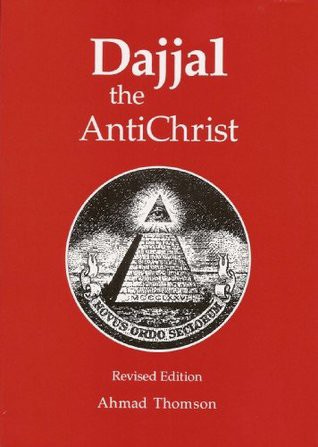
This was the mid-90s. In between that book, Ahmad Thompson’s classic red-fronted ‘Dajjal’ book (with the illuminati pyramid and all-seeing one eye) and the infamous ‘From the Shadows’ audiocassette, these became staples of my early fascination with this little niche sub-branch of Islamic knowledge known as eschatology (the study of the end times). Admittedly, due to this dramatic future world it portrayed, more often than not, I was one of those kids who would attend the mosque excitedly for an end of time type talk but then get bored during the ones on spirituality.
I grew up, life took over, and so it was soon forgotten (although I have to say I did notice some similarities to that future end-of-time world I imagined in the Lord of the Rings movies!). Until I discovered Shaykh Imran Hosein in the noughties. Here was a scholar now bringing not only credibility to this field but explaining it all in a way which made A LOT of sense. All of a sudden, I found myself studying and revisiting a lot of the end times signs but this time, I understood it with much deeper meaning and connecting the dots to the world we live in today. I realised it was now not just a nice-to-know, but an absolutely must-learn subject, especially as the reality it was showcasing was much more sinister than I had ever imagined.
Many people have said to me about my interest in eschatology that it’s all a bit doom and gloom, and also (more often) what’s the bloody point? How will this type of knowledge actually help you in real life? Islam is not a fatalist religion after all, so surely we need to focus on what we can actually practise here and now?
Good questions, to be fair.
And these questions are exactly what brother Abu Bilaal Yakub answers in his deeply fascinating, must-read book: The One-Eyed Impostor, Book One — Messiah and False Messiah: Identifying the Antichrist using Islamic Eschatology.
Abu Bilaal is a student of Shaykh Imran Hosein. I’ve known him for 5 years now. If I were to use one word to describe him, it would be deep. Another would be erudite. Another would be insightful. That paints somewhat of a picture of Abu Bilaal, yet still does not do him an ounce of justice. He is someone who is extremely passionate not just about learning — but learning with integrity, with utmost respect for our traditions and heritage at all times and using only the correct methodology. He not only wants to benefit, he also wants to elevate others. He is philosophical, a deep and critical thinker, and yet remains true to the Islamic essence. For him, knowledge-seeking is not just an interest, nor a passion, it is a highly sacred act of worship, and as such his reverence and diligence about every aspect of the process really stands out more than anyone else I know. Nothing is said or done without purpose. I am someone who is well-travelled, and fairly well-connected but I can honestly say I have never met someone like him.
The reason for sharing this insight into his personality that I have come to know over the years is that his writing deeply reflects his belief and values. Every astute observation, every penetrating insight (and there are plenty in this book), you get the feeling it has been something deliberated over, painstakingly so, before finally being put into words on paper. You can be sure what you are reading has been thoroughly researched, cross-referenced, duly filtered, past precedents poured over, and scholars consulted before the final copy you hold in your hands was published.
For a field that is forward-looking, such as eschatology, this is certainly not easy to do. Even less so, when you think about how little is known about Dajjal. One of the reasons we do not have that fear factor of him (despite his imminent reign of terror) that I alluded to in the opening gambit is we just do not ‘know’ enough. Ignorance is bliss, as they say.
This is a paradoxical situation Muslims today find themselves in.
On one hand, we simply don’t know enough about this future world, despite all the literature and ‘signs’ we have been provided with. And why bother, “we need to perfect our iman and deal with the here and now”, they say. But it is this lack of knowledge about this future world that is keeping us in our slump, without urgency, intention and defenceless against the onslaught of fitnah and deception of the world today.
Ironically though, through the lens of the infamous hadith of Jibrael where the Prophet Muhammad was asked multiple questions which taught us about Islam, Iman and Ihsan, the critical fourth element that is often forgotten are the questions he (SAW) was asked about the Hour. Therefore, it is not just a ‘nice-to-know’ subject or ‘let me focus on my prayers first brother’, it is as critical to Muslim success as our actions, our beliefs and striving for excellence are.
Not only is it a field we MUST look into because of what it means to be a Muslim; It is an absolutely fundamental discipline (and will be even more indispensable, in the future), even if it was never taught to us that way.
One quote that always stuck with me from a mentor at the start of my entrepreneurship journey was “don’t seek business success for the money you’ll make. Seek business success for who you’ll become along the way.” I apply the exact same principle to this subject, too. Sadly as a byproduct of our hyper-capitalist world we only seek to learn things we can earn from, or that seem to ‘appear’ to have a practical improvement to our life in some way. And with the subject of Dajjal and eschatology, as fascinating as it might be, we struggle with aligning the ‘why’ behind studying it, with the tangible benefits in our life.
This, aptly, is ‘one-eyed’ thinking, that Dajjal himself would be proud of.
Think about a modern pioneer of this field, Sheikh Imran Hosein himself. To understand this extremely difficult subject, who did he have to become? He is a former diplomat and seasoned scholar not just in Islam but also a scholar of economics and geopolitics. He is able to focus on the macro, the strategic big picture. He is able to connect the dots and see patterns and common threads where most do not. And then harness and shape all of these different strands into a coherent narrative that provides cutting-edge insight not easily replicated by many others. That type of skill is the byproduct of being a master in many fields. This is the power of polymathy — and it is no coincidence that Islam was formidable and in our golden age, at a time where polymathy was common. It is because solutions, insight and innovations happen at the intersection of different subjects, cross-industry and by fusing ideas together. Too much of our scholarship today is obsessed with only the micro — the fiqh of x, the sunnah of y etc. I am not belittling the need for detail but we need balance by studying both ends of the spectrum.
Naturally, Abu Bilaal is also a polymath. By reading this book, you’re left in no doubt about that. In the book, you’ll encounter themes as diverse as cosmology, philosophy, economics, science and the purpose of life and many, many more. It’s not about being impressed by the sheer number of themes you’ll encounter, or just how deep your thinking will become, and how soft your heart will become.
At the end of the day, what is life? The lives we experience are merely a byproduct of every decision we’ve ever made. If we want a transformation in our life, that happens by us making better decisions. Now imagine, having that type of understanding of the world, that Abu Bilaal is trying to impart to you? Do you think you’ll make better or worse decisions? Do you think you’ll understand life better or worse? What this book is all about, is where we are all heading, and tries to tackle the root cause, head-on. It is not a self-help book that is niched and will help you do a single x y or z. It is sharing with you that like it or not, all roads are leading towards the day where the biggest fitnah the world has ever seen will be here in human form. The world right now is being prepared for his arrival.
So this is the manual, the handbook you need to help you navigate and safeguard yourselves and your family from this despicable, deceiving character. So, in a nutshell, this is my summarised version of the answers to those two questions of why studying eschatology is important. But like those three words I used to describe Abu Bilaal earlier, it simply does not do this book an ounce of justice.
The discipline of eschatology, and this dangerous journey you will be taking, is one that is littered with lies, murky with mystery and drenched in deception. You cannot and must not take this journey without a sage, a guide holding your hand through the process and navigating you to find the light and answers you seek. Abu Bilaal Yakub is that guide to this journey you never knew you needed, but absolutely must take, for the good of yourself and your family.
May Allah accept your intentions and put barakah in your quest for truth and knowledge and bless Abu Bilaal for this gift for the Ummah, ameen!
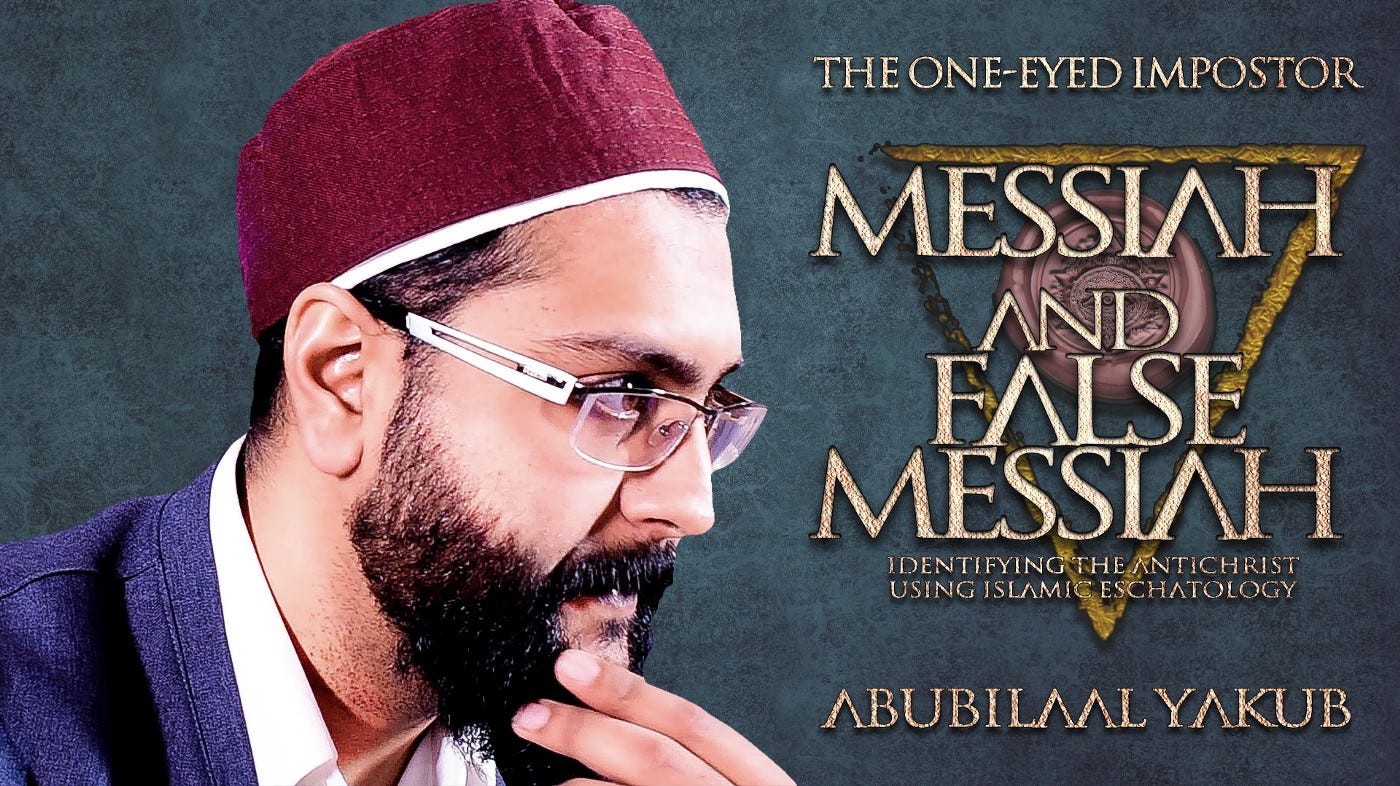
* This was written originally as my foreword for the book The One-Eyed Impostor, Book One — Messiah and False Messiah: Identifying the Antichrist using Islamic Eschatology which you can buy on Amazon here.