

What Should I Write?
What 1,400 years of Islamic thought about the pen says about the age of AI

It’s my wedding anniversary today.
Ten years ago today I got married, and as my wedding gift, my wife gave me a pen.
It was engraved along the barrel with my name, and engraved on the pen case is a line attributed to Abu Bakr (ra). “Knowledge is the life of the mind.”
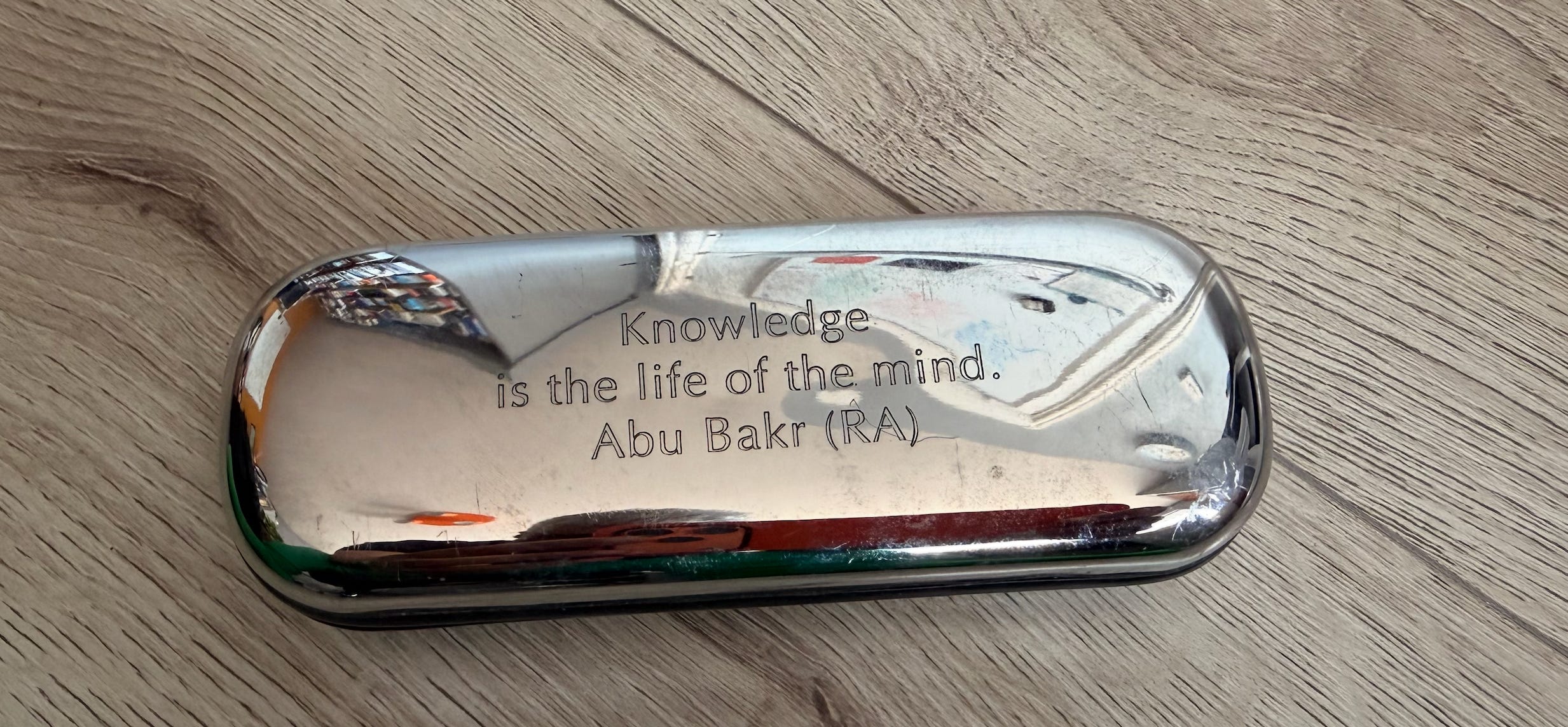
I’ll be honest with you. For most of these ten years it’s sat in a drawer while I typed everything. Books, essays, emails, even the birthday and Eid messages to family and friends.
The pen was ceremonial. A beautiful gesture, one that said she thought of me as a writer, someone with something to say. It was very thoughtful indeed. But she never expected me to use it, right? Ink on paper is slow, and I’ve had things to build and essays to type. I’ve picked it up maybe a handful of times in ten years.
Last month, her father died after a long battle with cancer.
In the weeks after, she told me something about him that was very moving. It starts with him asking for a pen.
“Ok, mujhe pen do”, he said. Give me that pen.
She’d asked him to write her birthday card when she was young, and she remembers standing there watching him do it. “Happy birthday meri pyari beti.” My lovely daughter. Then the card, along with a kiss and a hug.
More than twenty years on, the card is still in her memory box. When he got sick she showed him a photo of it and told him it had never left her special place. He replied with a single red heart emoji.
She says she can still feel the love in his handwriting. That the words pyari beti sit heavy on the page. Deep and heavyweight and meaningful, those were her words, describing pressure applied by a hand that is no longer here. It’s not what was said, it was what it symbolised. It was what was meant. And how much more it now means, given he is no longer here.
That card could have been printed or generated. It would probably have come out better written, cleaner phrasing, no crossings-out, maybe a witty poem to finish.
But it would have been worth nothing near the same.
I wanted to understand why.
Why should pressure on a page from twenty years ago outweigh anything a machine could produce today? Turns out, our tradition has a long and rich perspective on the pen…
The original question
There’s a narration in which the Prophet ﷺ said the first thing Allah created was the pen. He told it to write.
The pen answered with a question.
“What should I write, my Lord?:
Only then came the instruction: record the decree of all that will happen until the Last Hour. (Sunan Abu Dawud 4700; Jami’ at-Tirmidhi 2155, 3319)
Before anything else was created, the very first act of the first thing created was not writing. It was asking what it had been given.
Hold that thought. We will come back to it.
The three pens
Mufti Muhammad Shafi, in Ma’ariful Qur’an, comments on the verse “He taught by the pen” that the scholars speak of three pens in the world.
The first is the Pen of Decree. Allah created it and commanded it to record everything that would occur until the Hour, and its work is done. The Prophet ﷺ told Ibn Abbas that the pens have been lifted and the pages have dried. (Jami’ at-Tirmidhi 2516)
The second is the Pen of Recording. It belongs to the noble scribes at your shoulders. He does not utter a word except that with him is an observer prepared. (Qaf 50:18) Those angels compose nothing themselves. Their job is to take down every word and deed as it happens in real time.
The third is the human pen, the everyday pen by which people learn, teach, and preserve knowledge. This pen is part of Allah’s blessing to humanity because it turns spoken knowledge into something durable, cumulative and transferable across generations.
The first writer
Who was the first to use the pen?
Ibn Ishaq records that the prophet Idris (as) was the first man to write with a pen, and Ibn Kathir preserves it in his Stories of the Prophets. Idris (as) was the same man who was the first to cut and stitch cloth into garments, and the first to study the stars and track their movements. The Qur’an calls him truthful, a prophet, raised to a high station. (Maryam 19:56-57)
Writing didn’t arrive alone, in other words. It came bundled with clothing and astronomy, in the hands of a prophet. Three separate technologies for turning raw creation into human civilisation, were all delivered together.
An entire surah of the Qur’an is also named after this instrument. Surah Qalam.
Qalam comes from a root meaning to cut, to trim, to pare back. A reed on its own is not a pen. It only becomes one when someone takes a blade to it and cuts a nib. The instrument is defined by what was removed from it. And the man who first cut a reed into a pen was the same man who first cut cloth into a garment.
Even the ink was a made thing. Ink was just soot scraped from the inside of a lamp, gum, a little water. Worthless until someone worked it into something.
As simple as it sounds, that’s the method, right there.
Almost nothing in creation is useful in the state you find it. Something has to be cut away. A hand has to do the cutting, and a mind has to know where to place the blade.
And notice the order, too. Idris (as) didn’t invent writing and then go looking for something to say. He was first given thirty scrolls, and only after that did he teach his people to write.
Revelation came first. The technology followed, in order to carry it.
Read came first
The same order governs the cave.
The opening word revealed to humanity wasn’t build or conquer.
Read.
And read in the name of your Lord (meaning not in your own). You arrived created from just a clot, and whatever you know was placed in you by the One who taught by the pen, and taught man what he did not know. (Al-’Alaq 96:1-5)
Reception first, then production. The same sequence the pen followed at the beginning of everything.
A few verses later, a warning is given to mankind: “Man transgresses when he sees himself as self-sufficient.” (96:6-7)
Remember that word. Self-sufficient. It’s important.
The cost of Badr
What is the cost of this type of writing? There’s a famous story that gives us a suggestion of a price.
Seventy men sat in the dust outside Madinah with nothing to sell. They were the captives of Badr. The wealthy ones had already been ransomed by their families, some for thousands of dirhams. The ones left behind were the men with no money and nobody willing to send any.
The Prophet ﷺ set a different rate for them. “Take ten boys of the Ansar. Teach them to write. Complete the work and walk free.”
That was the deal. No money needed.
Think about who’s making that trade. A young community, cash-poor and freshly bloodied, holding seventy enemy fighters, and it takes literacy as its spoils. The Prophet ﷺ looked at a defeated soldier and decided the movement of his hand across a page was worth more than the coins in his house.
We hand that skill over for free now, and are mesmerised by the companies that take it from us.
The limit
Our tradition even tells you when the angels write nothing at all.
The pen is lifted from three, the Prophet ﷺ said.
From the sleeper until he wakes. From the child until he grows up. From the one who has lost his mind until it comes back. (Sunan Abu Dawud 4398)
Nobody is held accountable to what those three produce. The second pen is not active for these three. A sleeping man talks and it means nothing. A child says something cruel and we don’t hold it against him. Words come out and nothing is written down, because they were not fully in control of their rational faculty and therefore it may not have been meant.
Accountability follows intent in this case. Where nothing was meant, nothing is recorded.
Seven seas
And in case anyone ever mistook the written word for the whole of knowledge, the Qur’an closed that door too.
If all the trees on earth were pens and the sea were ink, replenished by seven more seas, the words of Allah would not run out. (Luqman 31:27)
We trained a system on close to everything our species has ever written down. LLM’s trained on almost every human word in existence.
Yet this verse disagrees. You can drain seven oceans and there is still more to explore, to ponder, to be revealed.
The sheer scale was never the same thing as knowing. You can have access to every word ever written and still not have the meaning of any one of them.
The tongue of the hand
There’s one more line that brings it all together.
“The beauty of writing is the tongue of the hand and the elegance of thought.”
The line is attributed to Imam Ali ibn Abi Talib (ra). This is about mechanism, about the process.
Your hand is how the interior gets a voice. Take the hand away (i.e. stop writing your thoughts) and the interior goes quiet, and you may not notice for years.
The law
Now I want to lay it all side by side, because there’s an interesting thread running through all of this.
The main conclusion is that nothing writes on its own authority.
The pen of decree wrote what it was commanded. The angels write what they witness. Idris (as) wrote what he was given. The reed had to be cut, the ink had to be made, and the first word of revelation was read, not write. Even the human pen has to know something, for it to convey and teach others.
With each of the three pens, every one of them receives before it produces.
And the weight and meaning of what lands on the page comes from the one who had intention, the one who meant it, which is why the record of deeds goes quiet when that intention is absent.
That’s what our tradition says about the pen, across fourteen centuries.
Now let’s bring the machine into the room.
Where the machine sits
So where does artificial intelligence fit among the pens?
It doesn’t. It’s not a fourth pen. It has no decree to record, no deeds to witness, no scrolls handed down to it. It’s just a copy of the third pen, built out of everything the third has ever made. Every letter, essay, argument and confession that human beings have ever pushed out of themselves into the open, has been scraped up, compressed, and handed back at unprecedented speed and scale.
If we hold it against the tradition, piece by piece, something strange happens.
Every pen receives before it produces. The first pen was given its instruction before it wrote a single word. Idris (as) was handed thirty scrolls before he taught a single student how to write and what to write. The first word of revelation was read: take in before you put out. The machine inverts this. It was not taught; it scraped. Nothing was ever entrusted to it. It swallowed the library whole, and it writes in its own name because nobody ever gave it one.
Writing exists to carry something specific. The scrolls came first, and writing followed to deliver them. Your pen exists for the same reason: to carry what’s inside you out to where another person can receive it. So ask what the machine is carrying. Ask it what it wants to say, and it has no real message. It will simply ask you what you’d like it to say. There’s no message in it waiting for a page. It’s a courier with empty hands until you hand it something.
Even all the writing in the world was never the whole of knowledge. That’s what the seven seas verse rules out: if every tree were a pen and every ocean ink, the words of Allah would still not run out. The written word is just a drop in the ocean, not the ocean itself. Yet we poured nearly every written word our species has produced into a machine and we think it is comprehensive.
The instrument is made by a hand, and used by one. A reed becomes a pen when someone cuts it. Soot becomes ink when someone works it. Sand becomes silicon when someone refines it, so up to this point the machine sits inside the oldest tradition there is: worthless matter meets human intelligence and becomes something new in the world.
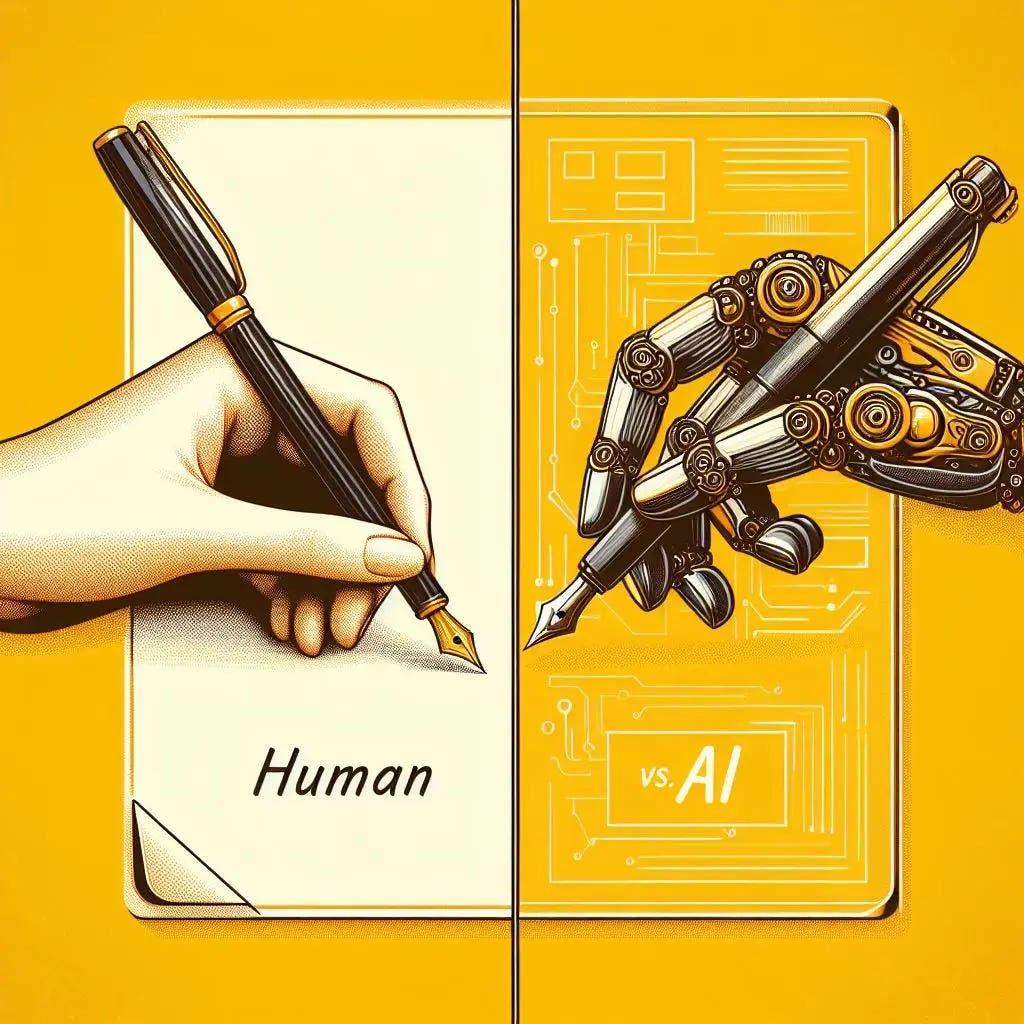
But here’s where it steps outside that realm. The pen needed your hand every single time it wrote, and the moving of your hand was the thinking, slowed down enough to land on paper. The machine needs your hand once, to type the prompt. After that it writes without you. You’re no longer in control.
For the first time in history, producing a page and thinking a thought have come apart. You can now produce without having thought, and the page will look identical to the page written by someone who did.
The reader can’t always tell. The angels can.
What the hand knows
Here’s what the changes at each stage remove from your mind.
Write by hand and you run at the speed of your fingers. It’s pretty slow. You can’t outpace your own thinking, so you have to know what you mean before the sentence is finished. The hesitation is doing the work. The tongue of the hand, exactly as described by Ali (ra).
Type, and you transcribe. The thought was finished before your fingers started typing. Any quicker, and something has gone from the process.
Now, you prompt, and you delegate the thinking part entirely. You describe the shape of a thought and let something else have it. You collect the artefact and skip the process, and the process was where you were supposed to change and develop.
The brain scans and recent research agrees.
In 2024, two neuroscientists at the Norwegian University of Science and Technology sat 36 students under EEG caps, 256 electrodes reading the brain’s electrical activity, and had them alternate between writing words with a digital pen and typing the same words. Handwriting lit up far richer connectivity across the brain than typing did. Van der Meer, who co-authored the study, tied that kind of connectivity to how memory forms and new learning takes hold. (Van der Weel and Van der Meer, Frontiers in Psychology, 2024)
The researchers Mueller and Oppenheimer had actually pointed at the same thing back in 2014.
Students taking notes by hand outperformed laptop note-takers on conceptual questions, because the slowness forced them to process instead of transcribe.
And last summer, the MIT Media Lab measured the third. Kosmyna and her colleagues ran 54 participants through essay-writing sessions in three conditions. No tools, search engine, and ChatGPT. Brain connectivity scaled down with each remove: the unaided group produced the strongest and widest networks, the search group sat in the middle, the ChatGPT group came last.
And the ChatGPT group couldn’t quote from essays they’d finished minutes earlier. In the first session, 83 per cent struggled to recall a single line, and not one of them quoted their own essay correctly. They also reported the weakest sense that the work actually belonged to them.
The authors called it cognitive debt. The sample was small and the research is young, so it’s more of a signal at this stage. But it should set off alarm bells. A person produces a document. The document is competent. Just minutes later they can’t tell you what’s in it, and they don’t feel it’s theirs.
Something was produced, but nobody was formed by the process. The result without the work, like paying a surgeon to carve you a six-pack.
It’s emptiness, articulated. You got the result without working for it. It’s cutting the cocoon of the caterpillar expecting a butterfly to fly out, without the metamorphosis having taken place. The wings form through the friction of trying to get out. Without that struggle, the transformation never takes place.
This is natural law. Friction IS the education. This is how transformation takes place. We keep removing the friction, then wonder why nothing stays.
There is a famous saying: “We shape our tools, and our tools then shape us.”
Ask what a tool that thinks for you is shaping you into.
The lifted pen, revisited
Let’s go back to the rule about the sleeper, the child, and the man who lost his reason. Because each of these did not mean the words that were said, nothing is written down by the angels.
That’s the machine, permanently. It produces without meaning anything, so nothing attaches to it.
The pen was lifted from your machine.
But it was never lifted from you. You are still responsible. You have been given the amanah. You are choosing to use the tool.
This changes something we’ve never had to think about before. For all of human history, anything that appeared under your name had passed through your intent first. You meant it, then you wrote it, then it carried your name. That was automatic. AI now cuts the link in the middle. Output detaches from meaning, but accountability doesn’t detach with it. It stays exactly where it always was.
You are now answerable for words you may never have meant.
For those MIT participants who didn’t feel the essays were theirs, that feeling was probably accurate. But the essays still carried their names, and their results don’t take into account how the words got there.
The gift
Let me now caveat all of this. None of this is a call to smash the machines.
AI is amazingly powerful and capable of taking us to greater heights. Muslims have often been lacking when it comes to technology so I am a big advocate for using it to close the gap and start to punch above our weight. But let’s put it all into context.
AI is raw material of the same order as the reed and the sand, potential capability waiting for a hand and an intention. So let’s use it. Let it carry the load, the formatting, the summaries, all the busy work. It can make you more productive than any generation before you, and there’s no piety in refusing a gift, especially a technology that can enhance our civilisation, just as pens, garments and astronomy once did.
Just know who you are and what you stand for before you open the prompt box. Know what you want to write, and what only you were given to say. Remember your amanah, the trust you hold. Be intentional, be careful, be purposeful.
That’s what the khalyfa does: he uses every tool creation offers, sand and reed alike, and keeps hold of the one thing no tool can carry for him, which is what he means. Meaning, in the age of AI, is everything. That’s what you own, that’s what is uniquely yours. That is part of purpose.
If you let go of that too, that’s a sure fire way to become what my book warns against.
Khaly.
Empty.
Back for the question
Nun. By the pen and what they inscribe. (Al-Qalam 68:1)
Think about what’s happening in that verse. In the Qur’an, Allah swears only by things of consequence: the dawn, the sun, the passage of time. Here He swears by a writing instrument, and by writing itself. That’s the status of the thing sitting in your drawer.
And the pen He swears by includes yours. The third pen. The one that carries what’s inside you out into the world and passes on what only you were given. Nobody else was handed it, and nobody else can use it, while the angels’ pen writes down what you do with yours.
Now, the machine. It will out-produce you. We know that already, and it’ll get better every day. Let it.
Here’s what I keep coming back to. The machine actually asks the first pen’s question.
What should I write, my Lord?
Every time you open it, this is exactly what it asks. What would you like me to write? It sits there producing nothing until somebody instructs it. It receives before it produces, like every pen before it, obedient to what a traditional pen has always been.
The only question is who it’s asking.
You. In this exchange, you’re the lord. You’re the one above it, handing down instructions, and it’s the instrument waiting on you. It has a lord, and it knows exactly what it is.
That’s the part to think about. This is now not about the machine at all. It’s about what happens to you while you use it. You now spend hours a day at the top of the chain of command, issuing orders and never receiving. To you, it feels like work, it feels like getting things done.
But this is where we need to remember the warning from Surah al Alaq. Man transgresses when he sees himself as self-sufficient. That verse was never a diagnosis of the machine. The machine is still the most dependent thing we have ever built, we can pull the plug tomorrow. This is a diagnosis of the man in the chair.
So here’s the question underneath the question. Who do you exist for?
You’re an instrument too, and you have a Lord to answer to.
If you know why you exist and who for, you can command each of the resources at your disposal in the correct way, deployed for maximum benefit and service and worship.
The machine asks you what to write.
Ask Him.
What should I write, my Lord? What did You give me to say here?
That second question is what purpose is all about. You were made for something specific, and part of it is a sentence nobody else has been given. Ask what it is often enough and you stop producing words and start delivering them.
Ask yourself that question, next time you sit and write - and it could change the intention. It could change the meaning. It will change what comes out, because now the words pass through you before they leave you. Even if you use AI to assist you. You know you will still be accountable for what you wrote.
A man once asked his daughter for a pen so he could say something to her that would outlast him. He’s gone, but the card is still in her special place, and the ink still carries the weight of his hand.
The seventy men outside Madinah bought their freedom with the movement of a hand. Writing is powerful. It’s worth something valuable. We must not lose this gift by outsourcing it to a machine.
Today, I’ve taken the pen out of the drawer.
It’s our anniversary today, and I owe my wife a card.
So I’ve been sitting with the blank page and asking myself that question.
What should I write?
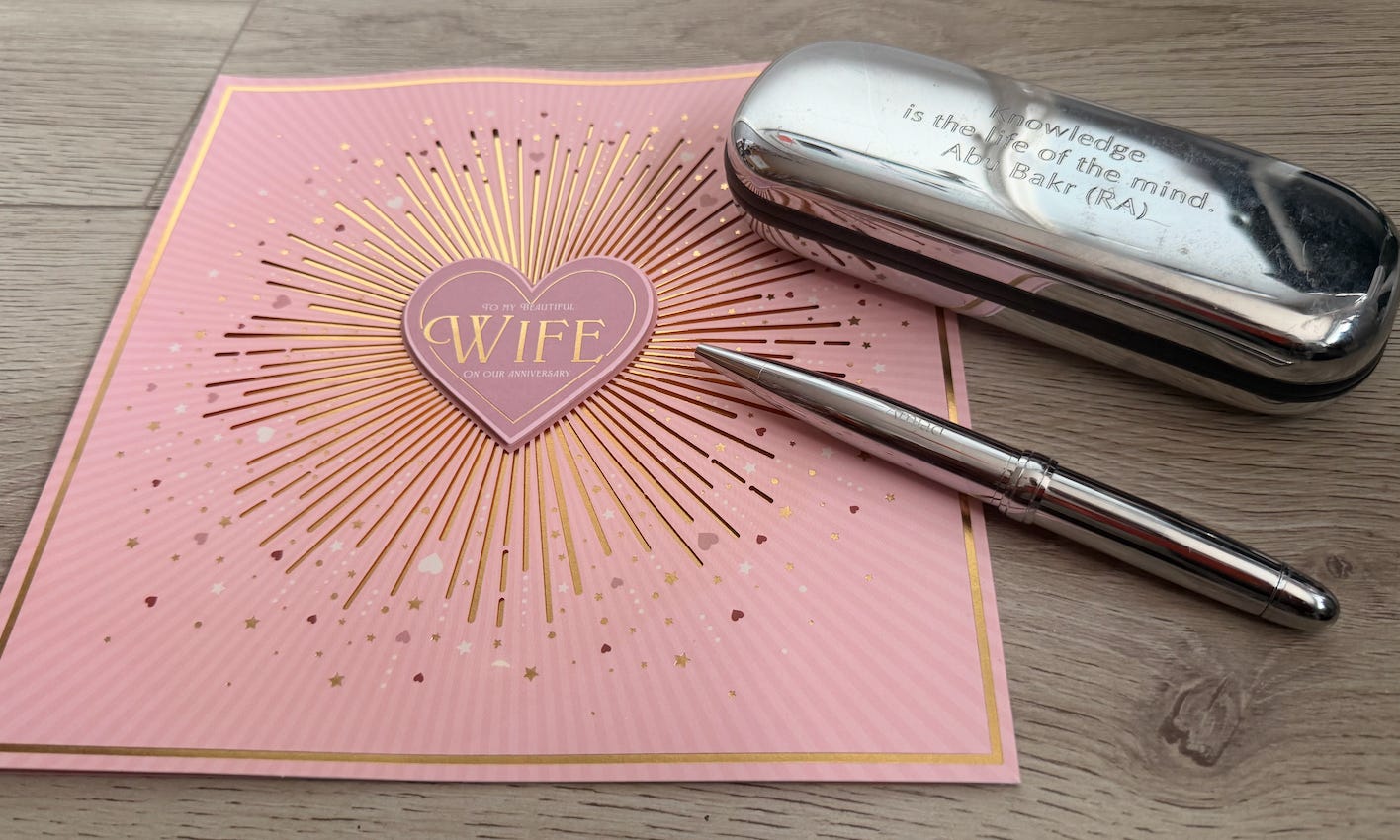
Well, I won’t tell you what I wrote. That part is between us. But it has a few crossings-out, and honestly, my handwriting is a lot worse than it was ten years ago. But I can honestly say that every word of it was meant. As it should be.
One day, insha’Allah a long time from now, perhaps it will sit in a memory box and mean something close to what her father’s card means now.
You see, I understand that nobody else can write what Allah has put inside me. And in the same way, absolutely nobody else can write what He’s put inside you.
Remember, the first thing created was an instrument for writing, and its first move was to ask.
AI never asks. It was never meant to.
Because AI can never be a khalyfa. But you, on the other hand, were created to be.
I explore the relationship between purpose and AI in my new book.
Khalyfa: Remembering Human Purpose in the Age of AI is out now. The full journey from khaly back to khalyfa, mapped through Surah Al-Kahf, stage by stage. The machines can have our calculations. They can never have our calling.
Written for Amaara, and for her father. Happy anniversary.
Excellent read. Jazzakum Allahu Khayran.
That is exactly the process I had to find out, because when a tool produces you something in less than a proper second, you have got to stop at some point and say hold on now, what have we got here? I’m the accountable, and this is the tool, here I am giving out commands all day everyday. What you wrote about Surah Al-Alaq clicks. We are lord over the tool, and the tool “works” so fast, we start to flow into “self-sufficiency” which the Surah warns of. SubhanAllah.
Thank you again for the great read and may Allah always keep us asking Him “what should I write, my Lord?”
Allah'ıma barik Lakuma, lots of prayers your way and a very thoughtful read. Learnt many new things, time to go back to the cave for a while and ask myself what I should write! Thank you! 🕊️